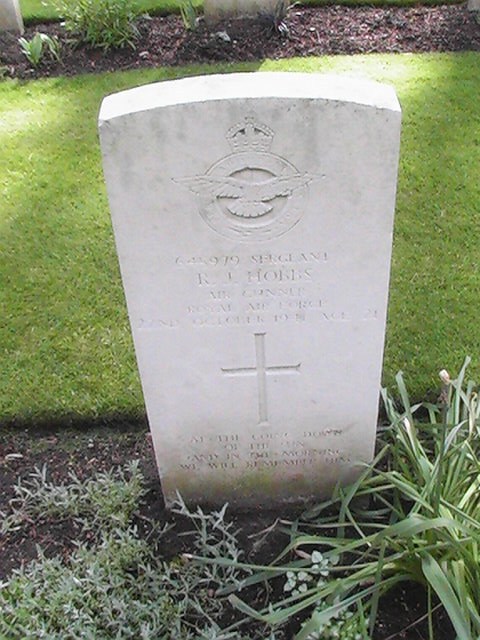
Sergeant Raymond Philip John HOBBS, 645979
On 22 October 1941, Raymond Philip John Hobbs was the Rear Air Gunner aboard Wellington Mk.IV R1765. The 458 Sqn ORB shows that R1765 took off from RAF Holme-On-Spalding-Moor on 22 October 1941 at 18:30 with Le Harve as the target. It also reports that the aircraft was hit by flak over the target area and returned to England in a crippled condition. Whilst flying over Surrey in England, the crew determined that the aircraft was no longer controllable and gave the order bail out. All the crew managed to do so, with the exception of Sgt Hobbs. The rest of the crew were P/O Sargeaunt, P/O Hickey, P/O Birnie, Sgt Shapir and Sgt Austin.
On 11 November 1941, Sqn Ldr L.L. Johnston conducted the Court of Inquiry/Investigation into the loss, with the surviving crew all as witnesses. This is available to view in a casualty file for a P/O Hickey for when he was in a separate incident.[1]
The location of the crash is given as “Tunnel Hill, Stoney Castle”, near Aldershot. This appears to be at approximately 51°17'13.2"N 0°41'25.8"W.
The inquiry states: “Five members of the crew
escaped by parachute. The tail gunner was killed. His body was found in the
wreckage of the aircraft. The tail gunner was not heard to acknowledge the
order “Prepare to Jump” and/or “Jump” and when called up a second time was assumed
to have jumped. The intercom had been good during the whole trip. Two members
of the crew were uninjured on landing by parachute.”
458 Sqn’s commanding officer, Wg Cdr Mulholland concludes:
“Reason of failure of Stbd engine not ascertained, possibly due to A.A. Fire
with possible damage to ailerons making A/C unmanageable on one engine. Rear
Gunner killed due to failing to comply with captain’s orders, through either
having “intercom” unplugged or damaged. Captain or 2nd pilot might
have tried visual training signal for abandoning A.C. This has been stressed
upon all crews.”
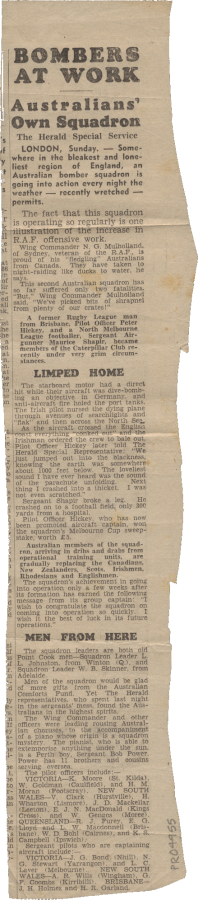
A newspaper article published in ‘The Herald’ (Melbourne) on 10 November 1941 describes the events ‘The starboard motor had a direct hit while their aircraft was dive-bombing an objective in Germany[2], and anti-aircraft fire hole the port tanks. The Irish pilot nursed the dying plane through avenues of searchlights and “flak” and then across the North Sea. As the aircraft crossed the English coast everything “conked out” and the Irishman ordered the crew to bale out. Pilot Officer Hickey late told The Herald Special Representative: “We just jumped out into the blackness, knowing the earth was somewhere about 1000 feet below. The loveliest sound I have ever heard was the sound of the parachute unfolding. Next thing I crashed into a thicket. I was not even scratched. Sergeant Shapir broke a leg. He crashed on to a football field, only 300 yards from a hospital.’ ~ The Herald, Melbourne, 10 Nov 1941, Page 4
[1]NAA A705, 163/36/138, pages 36-40 of 85
[2] It may have been common to deliberately report to the press that all raids were over Germany, regardless of where the target actually was. Though the idea of a Wellington “dive-bombing” anything would not have fooled the Germans.
The Second Pilot, P/O Bernard Peter Hickey, wrote in a letter to his parents: “I have had some amazing experiences since I last wrote to you, and have been very lucky. We were coming back from a raid over the continent the other night. After we had crossed the English coast, an engine packed up on us and the aircraft started to act alarmingly. We did everything in our power to keep it in the air, but it was impossible. Finally, we had to bail out.
We were very near the ground and were only at about 1000 ft when I jumped. I was very lucky and got away without a scratch. Of the crew of six, one chap was killed and we cannot understand what happened to him. He should have been the first to get away being the rear gunner. The other chaps are quite o.k. with a few slight injuries. I can only thank your prayers for my deliverance. We were also fortunate to get across the sea before the trouble started as we must have been hit by flack over the target.”
Another 458 Sqn Air Gunner, Sgt Athol Louis Opas, was flying on a different aircraft on the same raid. He wrote a letter home on 27 October 1941, and after describing his own experiences on the 22 October, wrote: “During this trip the plane Mo [Maurice] Shapir was flying in was hit so badly that they had to bale out. 4 of the crew were OK, Mo broke his leg, and the 6thmember didn’t quite make it.”
Alan Storr’s summary states that Raymond “was killed when the aircraft was hit by flak”, which isn’t definitively stated by the ORB, the inquiry, or the letters, which simply state that Raymond failed to bail out. It is possible, given that the intercom was reported to have been functional, that he had died from flak or was otherwise incapacitated and that is why he was unable to respond to the order to “jump”.
Raymond was born in Clapham, London, in late 1919. He was the son of John and Minnie Hobbs, of Melbourne Road in Merton, South London. He married Mary Monica Cranness Heald in Rochford in July, August or September 1941; what would only have been a matter of weeks before this incident.