Sergeant Alexander Lewis COX 400460
On 15 November 1941, Sergeant Alexander Lewis Cox was the Second Pilot aboard Wellington Mk.IV R1775. The crew of R1775 on this day were:
Pilot P/O Furey, Ronald John AUS404332
Co-Pilot Sgt Cox, Alexander Lewis AUS400460
Observer P/O Goldman, William AUS400403
W/O Sgt Rowland, Eric 1050936
Air Gunner, Front Sgt Pepper, Douglas Bertram 946888
Air Gunner, Rear Sgt Duffield, Henry William 745531
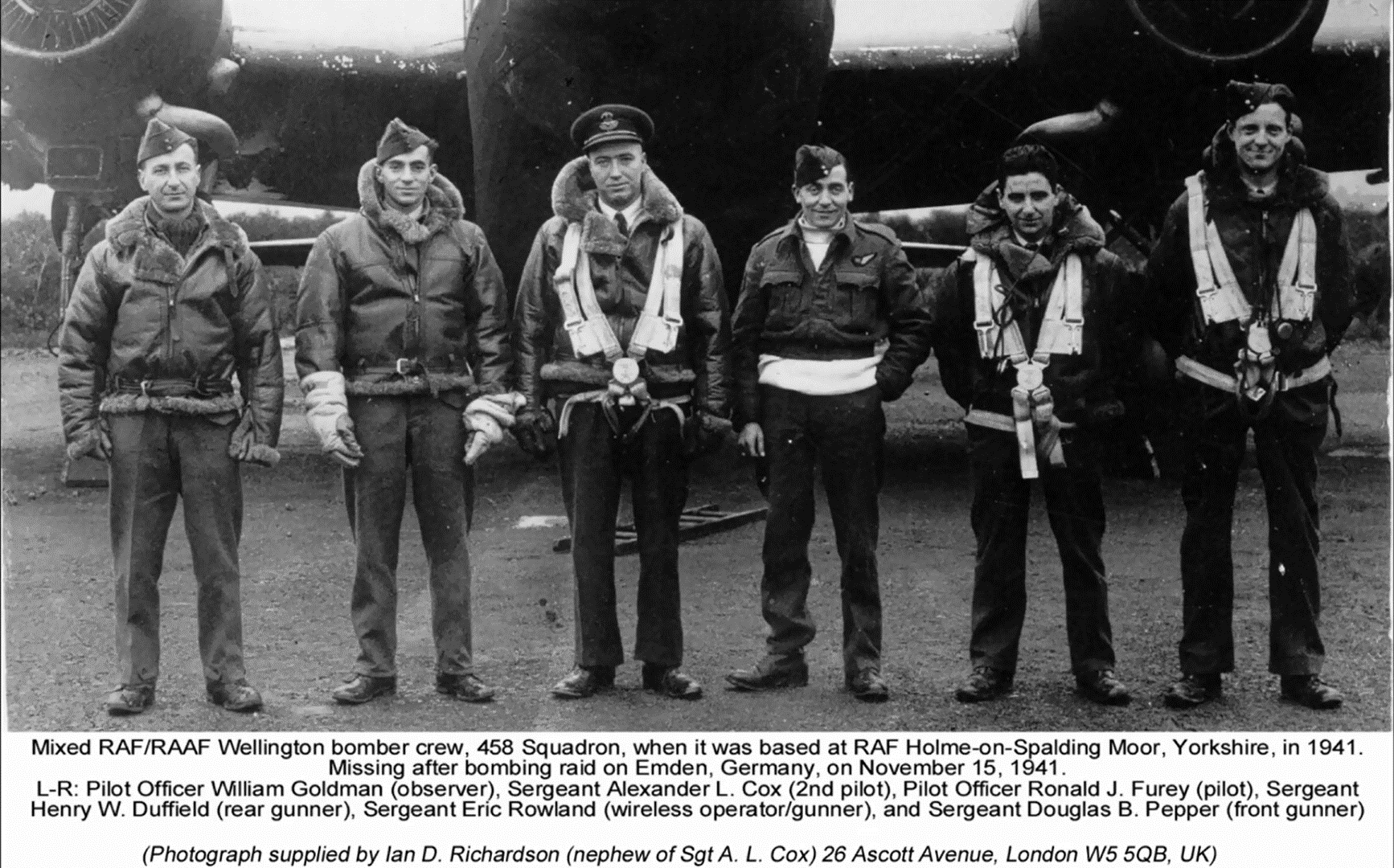
The 458 Sqn Operational Record Book states that that R1775 took off from RAF Holme-on-Spalding-Moor at 17:17 with the target as Emden, Germany. The record of events simply states that they did not return to base and that the last communication was received at 20:35.
Wg Cdr Mulholland wrote in his circumstantial report that “Three Q.D.M.s were given to this aircraft at approximately the time of E.T.A. at target, the last being strength 6. Nothing further was heard from this aircraft, and a square search by 7 aircraft as far East as 3 degrees East failed to reveal any information as to their whereabouts.” A QDM is a Magnetic heading to steer.
As mentioned by Mulholland and by the newspaper clipping below, 458 Sqn sent out 7 aircraft on 16 November 1941 to search the North Sea for evidence of R1775. Sgt Opas was a member of one of the crews sent to conduct the search, in a letter home he wrote: “Up to the time this letter goes to press I’ve done 6 trips & 1 North Sea sweep looking for one of our planes that came down in the said sea.”
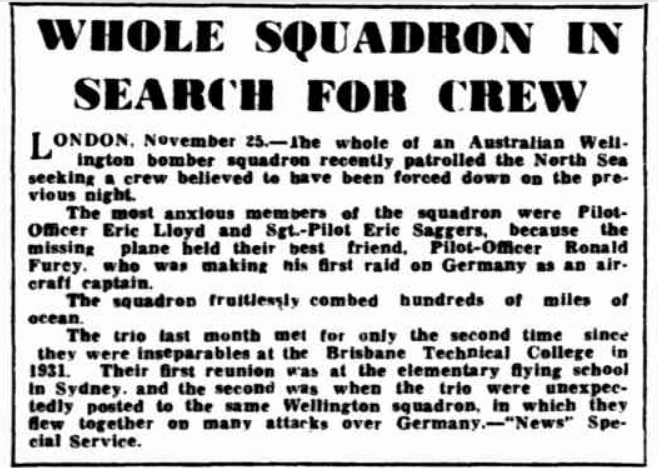
“News” newspaper, Adelaide, Wednesday 26 November 1941, Page 1
In a letter to Alexander’s father and First World War veteran Captain Arthur Joseph George Cox: “The last time contact was made with the aircraft was at the estimated time of arrival at the target, but after this time nothing further was heard from it, and although searches were made no trace of the aircraft or of any member of the crew could be found.”
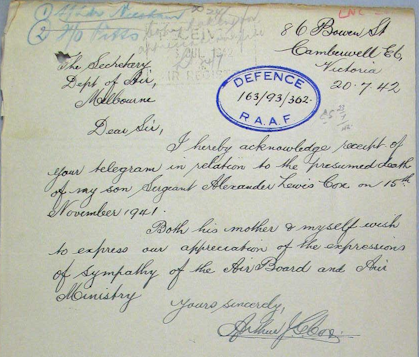
6 months later, the Air Board wrote to tell Captain Cox that, for official purposes, their son Alexander was now presumed dead. In reply, Captain Cox wrote “Dear Sir, I hereby acknowledge receipt of your telegram in relation to the presumed death of my son Sergeant Alexander Lewis Cox on 15th November 1941.
Both his mother & myself wish to express our appreciation of the expressions of sympathy of the Air Board and Air Ministry.
Yours sincerely Arthur JG Cox
A further letter sent to Captain Cox on 22 March 1949 stated that “all efforts to find any trace of your son’s aircraft or to establish whether the bodies of any members of the crew were ever recovered for burial, have proved unsuccessful. In view of this complete lack of evidence, it is now concluded that your son and his comrades were lost at sea.”
Alexander Lewis Cox was born on 1 November 1919 to Captain Arthur Joseph George & Ethel Cecilia Cox, of Camberwell, Victoria, Australia. Alexander finished school at Footscray Technical School in 1936, and continued to apply himself in education at evening classes, passing examinations in accountancy, book keeping and commercial principles. Prior to signing up to the RAAF in September 1940, Alexander spent a year with the 15th Field Brigade, Royal Australian Artillery whilst also working as a junior warehouseman where he obtained, according to his ‘application for air crew’, “experience in all Depts, wholesale softgoods warehouse, clerical, stock-keeping + selling.”
After signing up and completing Initial Training School (ITS), Alexander was first posted to No 8 Elementary Flying Training School (8EFTS) in Narrandera, New South Wales and then to No 4 Service Flying Training School (4SFTS) at Saskatoon in Canada where he earned his flying badge on 9 June 1941. After arriving in England Alexander was posted to 11 Operational Training Unit (11OTU) at RAF Bassingbourn in July and then finally to 458 Squadron in September.
Research by Ian D. Richardson, nephew of Sergeant Alexander Lewis Cox:
THE LOSS OF WELLINGTON BOMBER R1775 © Ian D. Richardson
| Source | Archive | Reference | Web Link |
|---|---|---|---|
| 458 Squadron Operational Record Book | NAA, Australia / The National Archives | NAA: A9186, 144 pages 24 and 29 | https://recordsearch.naa.gov.au/SearchNRetrieve/Interface/ViewImage.aspx?B=1359209 |
| Sgt Alexander L Cox, Service Record | NAA, Australia | A9300, 400460 | https://recordsearch.naa.gov.au/SearchNRetrieve/Interface/ViewImage.aspx?B=5549102 |
| Sgt Alexander L Cox | NAA, Casualty File | A705, 163/98/362 | https://recordsearch.naa.gov.au/SearchNRetrieve/Interface/ViewImage.aspx?B=651230 |
| P4 (Casualty) File | TNA, UK | AIR 81/10342 | https://discovery.nationalarchives.gov.uk/details/r/C16998589 Not digitally available, not yet viewed |
| Commonwealth War Grave Entry | CWGC | - | https://www.cwgc.org/find-records/find-war-dead/casualty-details/1085120/alexander-lewis-cox/ |